As an audio professional who frequently handles small to medium-sized events, over the past six months I’ve used the AMSaudio E300 wireless microphone system for campus parties, outdoor market performances, and internal corporate meetings. I’ve gotten to know this piece of equipment inside and out. Today, I’ll share my first-hand experience with this entry-level true diversity dual-channel wireless microphone system—no exaggeration, no fluff, just real insights to help those who are considering it.
Let me start with why I chose it in the first place. Simply put: limited budget, but still needed reliability. For small and medium events, equipment budgets are naturally tight. Spending several thousand—or even tens of thousands—on professional microphones just isn’t realistic. But going too cheap isn’t an option either. I once used a low-cost wireless mic that suffered from signal dropouts and constant noise during a show—it nearly ruined our reputation. I came across the AMSaudio E300 by chance. Its specs and reviews seemed balanced, and with a price of RMB 1599, it fit perfectly within our budget, so I decided to give it a try.
The first time I used it was at a school New Year’s party, with nearly 300 students and teachers attending. The stage wasn’t large, but there were plenty of lighting systems, audio gear, and projectors—all potential sources of signal interference. Honestly, I was a bit nervous before turning it on, worried about possible dropouts. But the first pleasant surprise came quickly: the one-touch frequency scanning feature. It’s incredibly convenient—no need to manually adjust frequencies for a long time. Just press and hold the button, and it quickly finds the optimal frequency. Pairing was faster than other mics I’ve used in the same price range. Within a few minutes, both handheld microphones were ready, saving a lot of setup time.
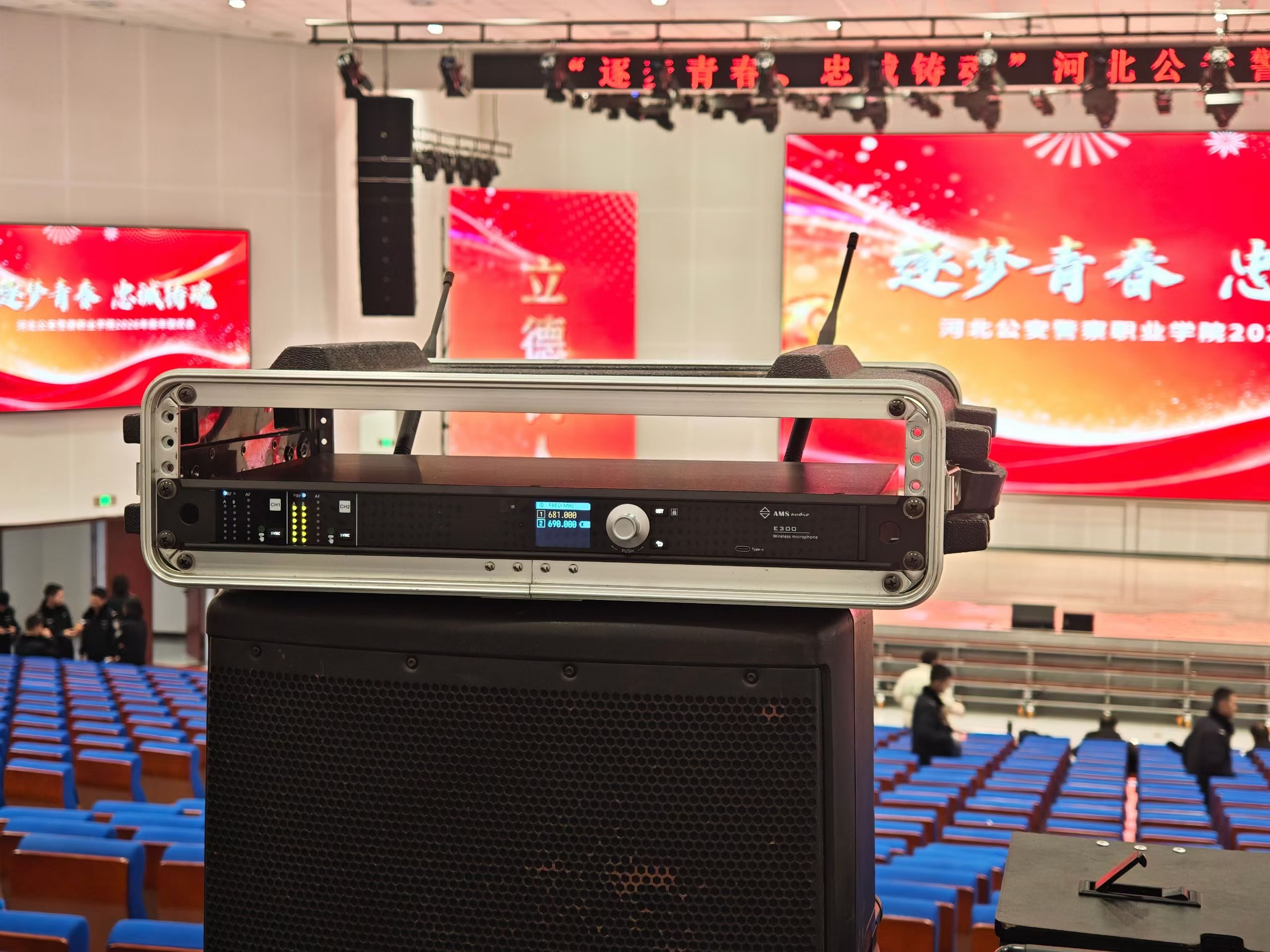
AMSaudio E300 True Diversity Dual-Channel Wireless Microphone System
During the event, there were singing performances, poetry recitations, and comedy skits, lasting nearly three hours in total. The E300 performed steadily throughout. Singers moved freely across the stage, even interacting with the audience at the edge, and there were no dropouts or interruptions. The sound quality was clear, with no noticeable noise or distortion. That said, one thing to note: the microphone is very sensitive at close range, but if the speaker moves too far away, the volume drops slightly. This requires some adjustment in mic distance, but it’s a common trait among wireless microphones and not a major drawback.
Another strong point is battery life. With a full charge, the handheld microphone lasted over four hours during the event and still had power remaining afterward. According to official specs, a single battery can last up to 20 hours, which is more than sufficient for half-day or full-day small to medium events. There’s no need for frequent battery changes or mid-event charging, which is very convenient.
Of course, no product is perfect, and I should mention a minor downside. The system supports up to 12 channels, which is fine for small and medium events. However, for large-scale performances involving multiple vocal parts or instruments, it may not be sufficient and would need to be used alongside other equipment.
Overall, after using it for some time, my evaluation of the AMSaudio E300 is: “practical and sufficient.” It doesn’t have the fancy features of high-end microphones, but it also avoids the obvious flaws of cheap ones. It hits the sweet spot for small to medium events—stable, easy to use, and cost-effective. For teams with limited budgets, schools, companies, or professionals handling outdoor events, this system is a great fit. It meets essential requirements for sound quality and stability, and it’s simple enough that even beginners can get started quickly without professional tuning skills.