Having been in the wireless audio field for years, I’ve handled a lot of antennas. Lately, colleagues keep asking me: “Hey, everyone says blade antennas are better than whip antennas—true or not?”
This rumor circulates heavily in our circle, claiming blade antennas are more stable, transmit farther, and have higher sensitivity than whip antennas (the traditional rod-style type). Personally, I trust data more than hearsay—especially in our industry. At a live show, a slight signal issue can cause a disaster. So I decided to test it myself.
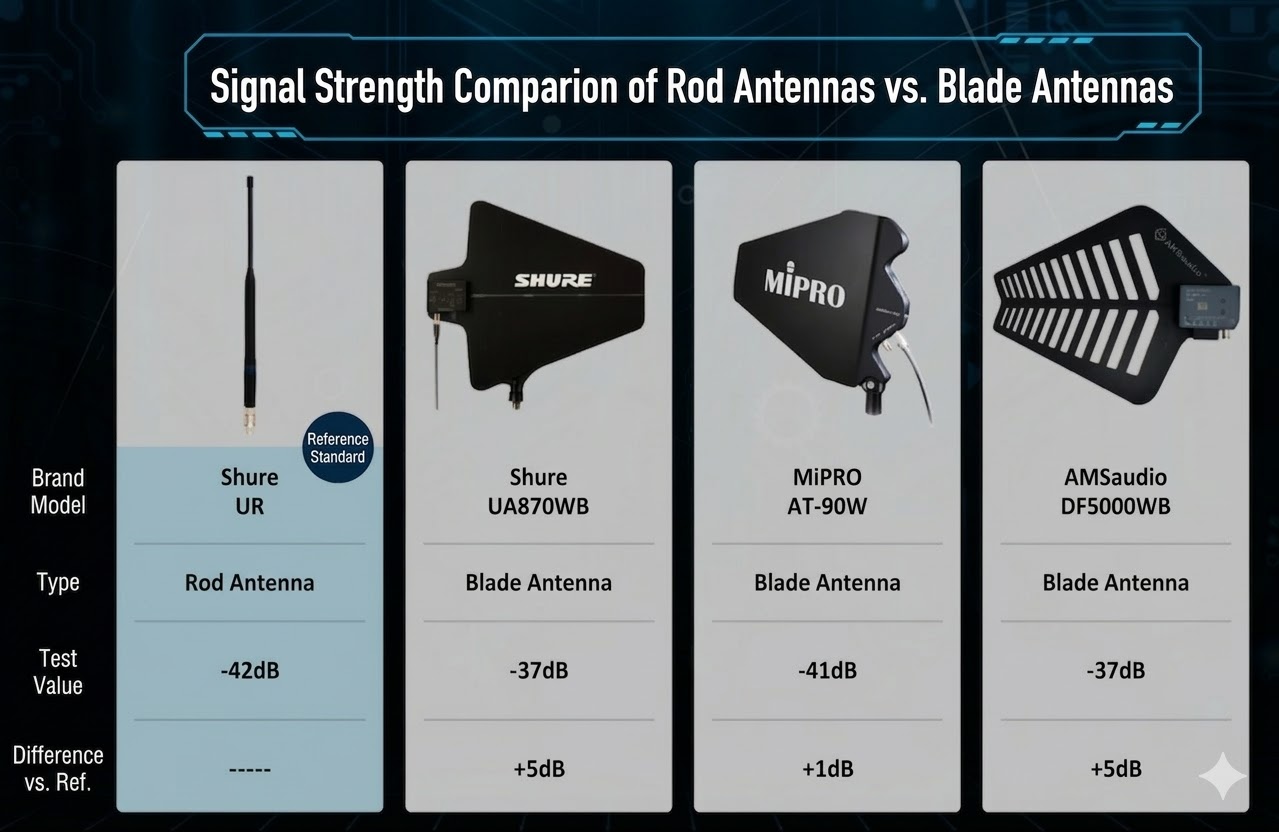
I picked three popular blade antennas on the market, and a classic whip antenna for comparison. Same environment, same equipment, fair test—let the data speak.
Tested Models:
Shure UV870WB Blade Antenna (well-known, consistently good reputation)
MiBao AT90W Blade Antenna (commonly used in small-medium venues, good cost performance)
AMSaudio DF5000WB Blade Antenna (less common but strong performer, used by some professional teams)
Reference: Shure Whip Antenna (industry baseline)
Test Conditions Standardized:
Spectrum analyzer: JD745A (USA)
Signal source: Shure UR1 bodypack, fixed frequency 750MHz
Open hall, no obstructions or interference
Both transmitter and receiver antennas fixed at 1.3m height, distance 5m
Same coax cable: Butterfly RG58-300 to avoid line loss influence
Results:
Whip antenna (baseline):
Spectrum reading: -37 dB. Remember this number for comparison.
.jpg "unnamed (1)")
Blade 1: Shure UV870WB
Spectrum reading: -33 dB → 4 dB stronger than whip. Pretty good, but not “overwhelming.”
.jpg "unnamed (2)")
Blade 2: MiBao AT90W
Spectrum reading: -37 dB → identical to whip.
.jpg "unnamed (3)")
Blade 3: AMSaudio DF5000WB
Spectrum reading: -30 dB → 7 dB stronger than whip, the dark horse of this test.
.jpg "unnamed (4)")
Observation:
Among the three blade antennas, one is equal to the whip, two are stronger—but the difference isn’t as dramatic as some claim. Considering wireless microphones have roughly 60 dB dynamic range, a 4–7 dB difference might not be clearly noticeable in real use.
.jpg "unnamed (5)")
.jpg "unnamed (6)")
Conclusion:
The statement “blade antennas completely beat whip antennas” doesn’t hold up. At least in terms of sensitivity, the gap isn’t as big as the rumors suggest.
But why do many colleagues report that blade antennas feel more stable or have longer range on-site?
I think it may be due to the blade’s structure—a flat design could have a wider radiation angle, giving some advantage in complex environments (better obstruction and interference resistance). It could also be about installation convenience and better adjustability—the practical experience may feel smoother even if the raw numbers aren’t dramatically different.