AMSaudio Makes Wireless RF Easy to Understand
In any professional wireless microphone system, the antenna plays a critical role in maintaining reliable signal transmission. Choosing the right antenna can significantly improve RF performance, especially in complex live environments.
But what exactly is the difference between an active antenna and a passive antenna?
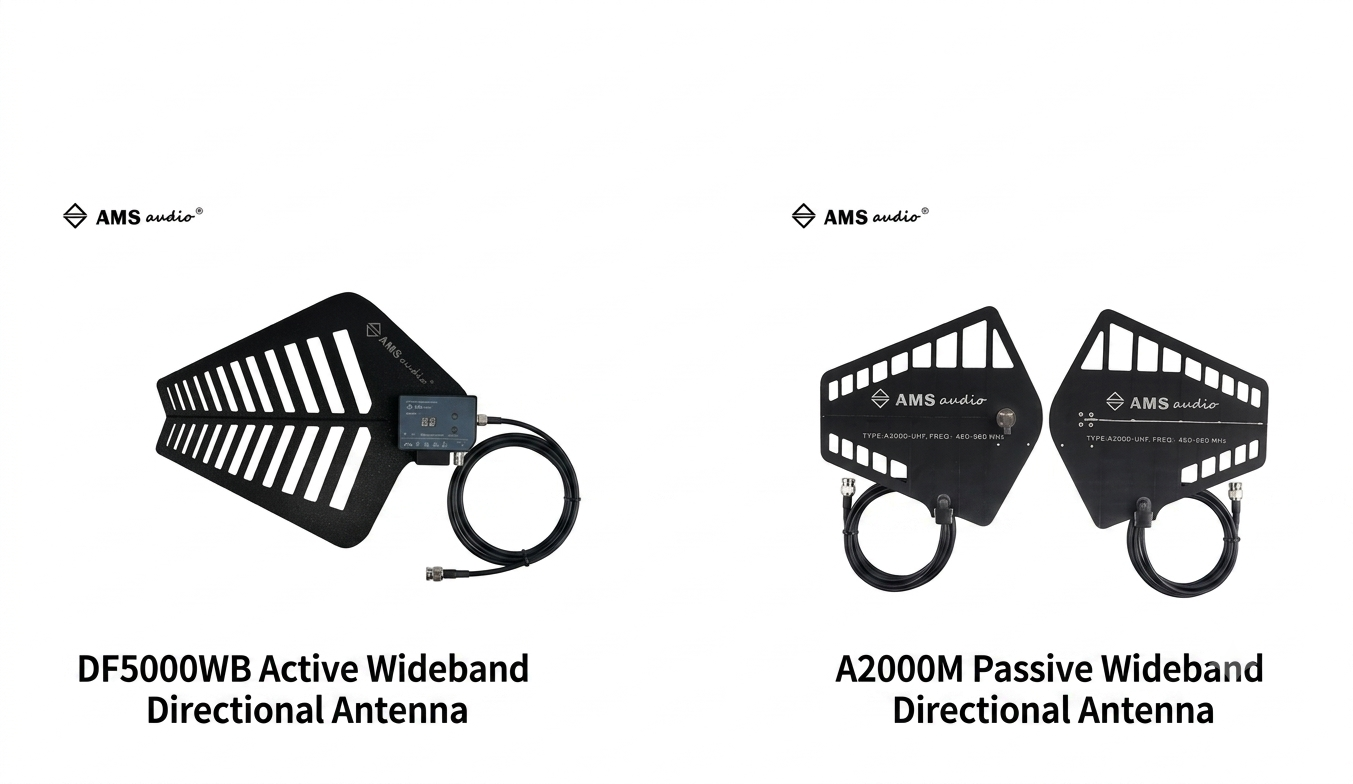 Let's break it down.
A Quick Way to Tell Them Apart
The easiest way to distinguish an active antenna from a passive antenna is by looking at the antenna itself.
If the antenna has an integrated amplifier module with a power indicator (LED), it is an active antenna.
If the antenna has no amplifier module and no indicator light, it is a passive antenna.
It's that simple.
What Is a Paddle Antenna?
.png "Gemini_Generated_Image_hwz787hwz787hwz7 (1)")
The antenna commonly used in professional wireless microphone systems is known as a log-periodic directional antenna (LPDA), often referred to in the industry as a paddle antenna or shark-fin antenna.
Compared with standard whip antennas, paddle antennas provide stronger directivity and better RF reception, making them ideal for live performances, conferences, broadcast applications, and large-scale events.
What Makes an Active Antenna "Active"?
At first glance, an active antenna looks almost identical to a passive antenna.
The key difference is that an active antenna incorporates an RF amplifier.
Some manufacturers integrate the amplifier directly into the antenna housing, while others use a detachable amplifier module that can be added to a passive antenna. Regardless of the design, both approaches perform the same function—compensating for signal loss during cable transmission.
In other words:
A passive antenna + an external amplifier module = an active antenna.
Why Is an RF Amplifier Necessary?
Every RF signal loses strength as it travels through coaxial cable.
The longer the cable, the greater the signal attenuation.
Different cable types also introduce different levels of loss. For example, commonly used RG58 and 50-3 coaxial cables typically experience approximately 0.4–0.6 dB of attenuation per meter.
Without compensation, long cable runs can significantly reduce the signal reaching the wireless receiver, affecting system performance and reliability.
An active antenna solves this problem by amplifying the RF signal before transmission through the cable. The amplifier is carefully designed to offset cable loss, allowing the signal arriving at the antenna distribution system or receiver to remain as close as possible to its original strength.
The goal is simple:
Compensate for cable loss—not over-amplify the signal.
This helps maintain stable, reliable RF performance, particularly in large venues where long antenna cable runs are unavoidable.
Which Antenna Should You Choose?
Both active and passive antennas have their advantages.
Passive antennas are ideal for shorter cable runs where signal loss is minimal, offering a simple and cost-effective solution.
Active antennas are better suited to longer cable distances or more demanding RF environments, where cable attenuation needs to be compensated to maintain consistent wireless performance.
Choosing the right antenna depends on your system design, cable length, and application requirements.
AMSaudio RF Solutions
At AMSaudio, every antenna solution is designed around real-world applications.
Whether your project requires long-distance RF transmission in a large venue or a straightforward wireless setup for smaller events, AMSaudio offers antenna solutions that deliver dependable performance and stable signal transmission.
Because reliable wireless audio starts with choosing the right antenna.
Become an AMSaudio Exclusive Distributor
AMSaudio is currently expanding its global distribution network and is seeking one exclusive distributor in each country.
If your company specializes in professional audio distribution, commercial AV, system integration, or live event solutions, we welcome the opportunity to establish a long-term partnership.
Contact Us
Luna
WhatsApp / WeChat: +86 198 0520 8160
Email: amsaudio888@gmail.com
Address: Building A6, Hantian Technology City, Foshan, Guangdong, China
We look forward to building a successful future together with our global partners.